Safe Property Recovery
Quickly clear dangerous hang-ups and heavy fallen timber so repairers and your family can move around safely.
Thorough post-storm cleanup, canopy hazard reduction, and fallen timber clearing in Pallarenda.
Serving all storm-affected streets and beachfront properties in Pallarenda.
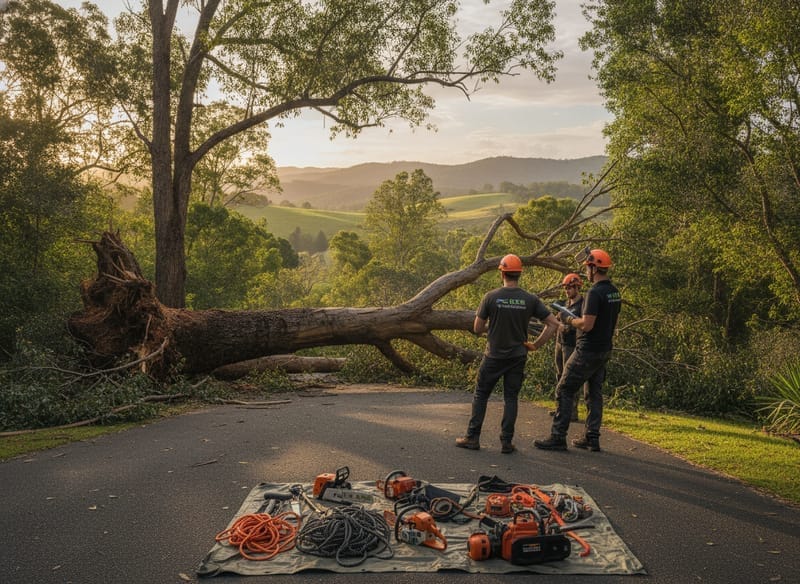
Following severe weather events in Pallarenda, our storm damage tree removal service clears broken canopies, dangerous hung branches, and uprooted trees to restore complete property safety.
Severe weather events like Cyclone Kirrily demonstrate how vulnerable coastal Townsville species are to uprooting. In Pallarenda, heavy rainfall quickly supersaturates sandy ground, causing top-heavy trees with restricted root plates to tilt or collapse entirely.
Quickly clear dangerous hang-ups and heavy fallen timber so repairers and your family can move around safely.
Remedial pruning removes torn branch stubs cleanly, protecting surviving trees from fungal infection and decay.
Clear invoices and professional arborist reports streamline approval through your insurance provider.
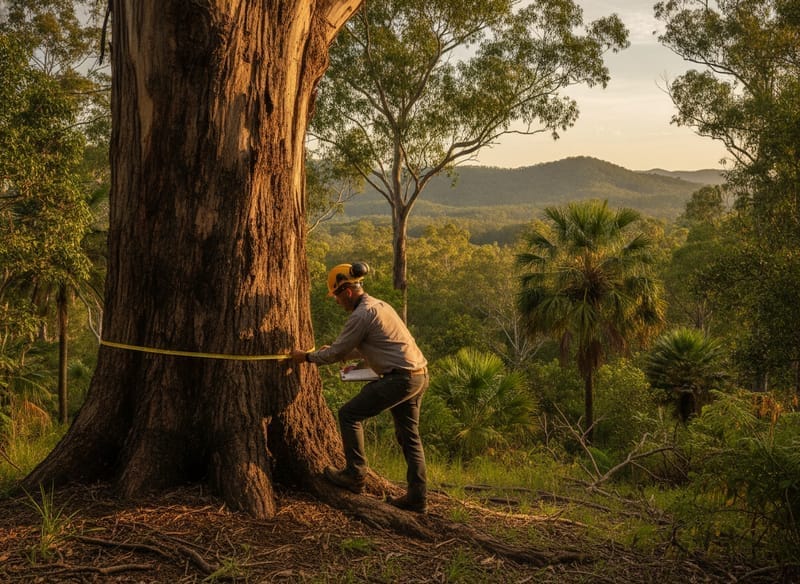
We inspect the entire block to identify immediate structural hazards, hanging limbs, and ground tension.
Our arborists carefully relieve rotational and compressive forces in fallen trunks to avoid kickback.
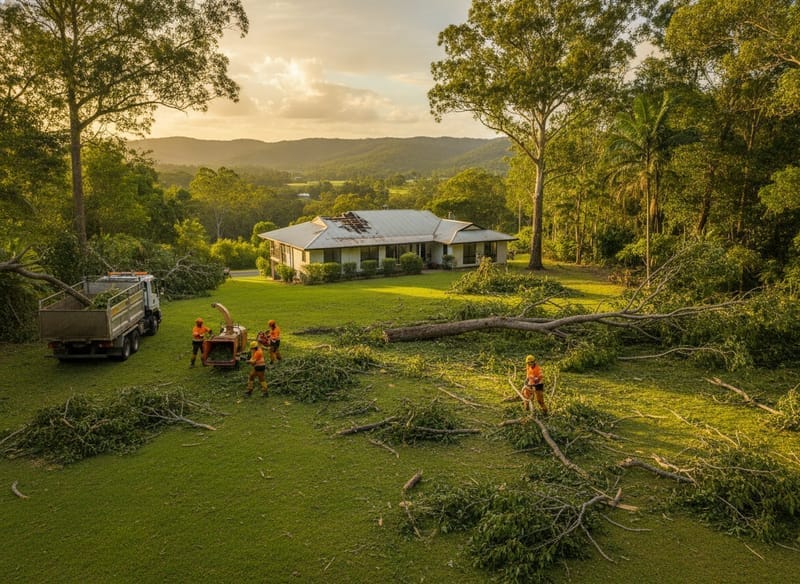
We process fallen branches through our commercial chipper and cut heavy logs into manageable lengths.
We rake and clear all storm debris from your property and provide full paperwork for your insurer.
Townsville’s dry tropics climate is exceptionally tough on established vegetation, but when intense wet-season rains are followed by cyclonic winds, the results can be devastating. If you are dealing with fallen branches, hung-up canopies, or completely uprooted trunks on your coastal property, our team is ready to deliver the professional Storm Damage Tree Removal Pallarenda residents can rely on.
After major weather events like Cyclone Kirrily, we see firsthand how the coastal exposure in Pallarenda combined with saturated soils leads to catastrophic root-plate failures. Our region spends most of the year under severe drought stress, meaning trees often have compromised root systems. When the ground rapidly transitions from concrete-hard to waterlogged during a cyclone, top-heavy species are primed to fail.
We are your local, highly equipped arborists. Whether a Yellow Flame Tree has dropped heavy limbs onto your roof or a massive African Mahogany has completely uprooted across your driveway, our team provides safe, efficient, and fully insured emergency dismantling to secure your property.
Cleaning up after a violent coastal squall might look like a straightforward chainsaw job, but storm-damaged timber is incredibly unpredictable and dangerous. Fallen or twisted trees in Pallarenda often hold massive amounts of trapped tension and compression. When an unqualified homeowner makes a standard cut, that stored energy can release violently. This can cause the log to "barber-chair" (split vertically), spring back, or roll unexpectedly, leading to severe injury or further structural damage to your home. Furthermore, many property owners react to canopy damage by "lopping" or topping trees that might actually be salvageable. This outdated practice strictly violates the AS4373 Pruning of Amenity Trees standard. Lopping leaves large, raw stubs that are prone to rapid decay and promotes weak, epicormic regrowth. In the dry tropics, this effectively turns a survivor tree into a guaranteed hazard for the next cyclone season. Our AQF Level 3 climbing arborists know exactly how to read wood under tension. We execute safe, AS4373-compliant relief cuts and rigging strategies to dismantle hazardous trees without risking your infrastructure. We provide the expertise to safely remove the unsalvageable and properly prune the survivors, saving you from a much larger disaster down the line.
Responding to cyclonic wind damage requires highly specialized techniques. Standard felling practices do not apply when a tree is already on the ground, twisted, or structurally compromised. Here is how our professional crews handle complex storm cleanups.
Upon arrival, we tag and prioritize trees based on immediate risk. High-priority hazards overhanging rooflines or power feeds are addressed first, followed by hung-up secondary hazards, and finally, open-ground cleanup of snapped limbs.
Using professional ground saws like the MS500i or 572XP, our operators assess bind and trapped energy in twisted trunks. We use advanced step-cuts and bore-cuts to safely sever fallen timber without the log rolling or snapping back.
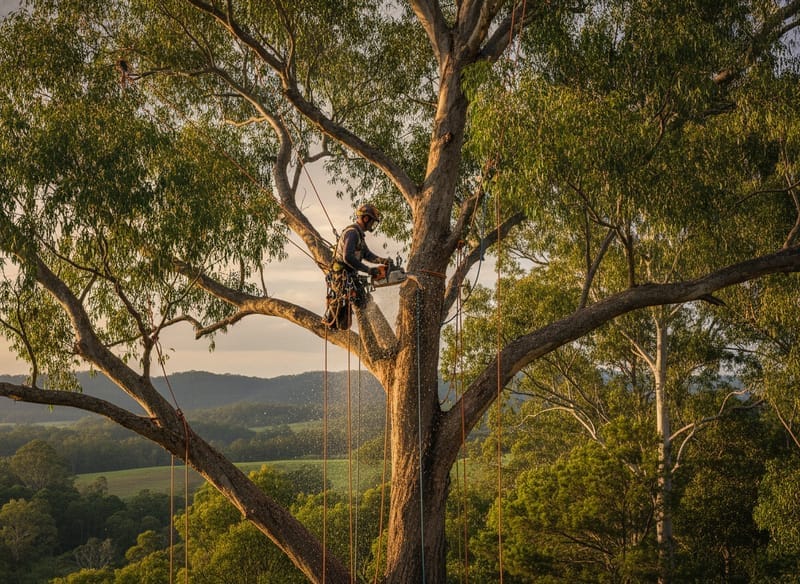
For damaged canopies where Elevating Work Platforms (EWPs) cannot reach due to soft ground or steep terrain, we utilize double-rope climbing techniques. We rig and lower hung-up branches safely to the ground using friction devices, ensuring zero impact to structures below.
When a massive River Blue Gum or African Mahogany has uprooted and is resting directly on a house, we deploy mobile cranes or loader cranes (HIABs). This allows us to safely lift heavy trunk sections away without transferring any weight or shock to the building structure.
Uprooted trees pose a unique danger: once the heavy trunk is severed, the massive root ball can suddenly snap back into the crater. We stabilize the root plate before making the final cut, safely grinding or burying the remnants depending on the site requirements.
When severe cyclonic weather batters Townsville, our response process is built for speed, safety, and thorough insurance documentation. First, you contact us to report the immediate damage. We dispatch our crew to your Pallarenda property to conduct an urgent site triage. We walk the grounds to identify imminent hazards—such as a heavily leaning Weeping Fig or snapped branches suspended over your driveway—separating these critical issues from standard green waste. Next, we provide a detailed, itemized quote breaking out every job line. Because we know insurance companies require pristine evidence, our team takes comprehensive before-and-after photographs of the damaged trees, their proximity to your infrastructure, and the specific failure points before a single chainsaw is started. Once authorized, our team deploys with the appropriate heavy equipment, from top-handle climbing saws to EWPs and 12-inch capacity wood chippers. We focus entirely on make-safe work first: stabilizing uprooted trunks, releasing tension, and rigging down hung-up branches. Finally, we process all timber, load the logs into our tipper trucks, and perform a complete site cleanup so your property is safe and accessible once again.
Storm recovery work is inherently high-risk, making our strict adherence to safety protocols non-negotiable. All of our restorative pruning complies entirely with the AS4373 Pruning of Amenity Trees standard, ensuring we do not compromise tree health through poor cutting practices.
Our operations are conducted by arborists holding AQF Level 3 qualifications, backed by specialized tickets including Working at Heights (RIIWHS204D) and Elevating Work Platform operations. For major developmental sites or complex hazard disputes, we also supply AQF Level 5 consulting arborist reports in accordance with AS4970 Protection of Trees on Development Sites.
For your complete peace of mind, our business is fully public liability insured and maintains comprehensive WorkCover for all employees. We ensure every job is thoroughly documented to support your storm damage insurance claims.
Working in Pallarenda means dealing with a unique blend of coastal sand, extreme salt exposure, and the intense wet/dry cycles of Townsville. During cyclone events like Kirrily in January 2024, the primary failure mechanism we see is uprooting. African Mahoganies are particularly notorious here; many were planted decades ago with root deformities from nursery pots, which finally fail when 100km/h winds hit saturated coastal soils. Fortunately, clearing this damage is rarely hindered by red tape. Townsville City Council is one of the freer jurisdictions in Australia for private tree removal. There is no general tree preservation order and no permit scheme for standard private trees. The only major council trigger is the OM-08 very high importance area under the Natural assets overlay, but even then, storm damage changes the rules. The State’s Vegetation Management Act 1999 provides a standing exemption for clearing necessary to remove an imminent risk of serious personal injury or structural damage. This allows us to act to protect your home. The only strict line we must observe on waterfront Pallarenda properties involves mangroves, which are entirely protected under the Fisheries Act 1994. Our local knowledge ensures your emergency cleanup is rapid, safe, and perfectly legal.
Once the immediate Storm Damage Tree Removal Pallarenda operation is finalized, your remaining trees will require careful observation. The surviving trees have likely endured immense wind stress and root rocking. Keep a close eye on the ground around the base of your remaining large trees. Look for new cracks in the soil, soil heave, or a sudden lean, as these indicate partial root plate failure that could collapse later. Watch for rapid epicormic growth (clusters of small shoots on the trunk) or sudden canopy dieback, which signal severe tree shock. If the storm exposed termite hollowing in snapped branches, or if you suspect a tree has been quietly destabilized by the wind, do not wait for the next wet season. Call our team back to arrange a formal AQF Level 5 hazard assessment to secure your property long-term.
Storm damage clearing costs vary according to the volume of fallen timber and structural hazard level.
We provide transparent on-site quotes with clear itemization for private property owners and insurers.
We provide storm damage tree removal across Pallarenda and neighboring Townsville districts.
Professional storm cleanup, tension-timber cutting, and insurance documentation.
Request Storm Cleanup Quote